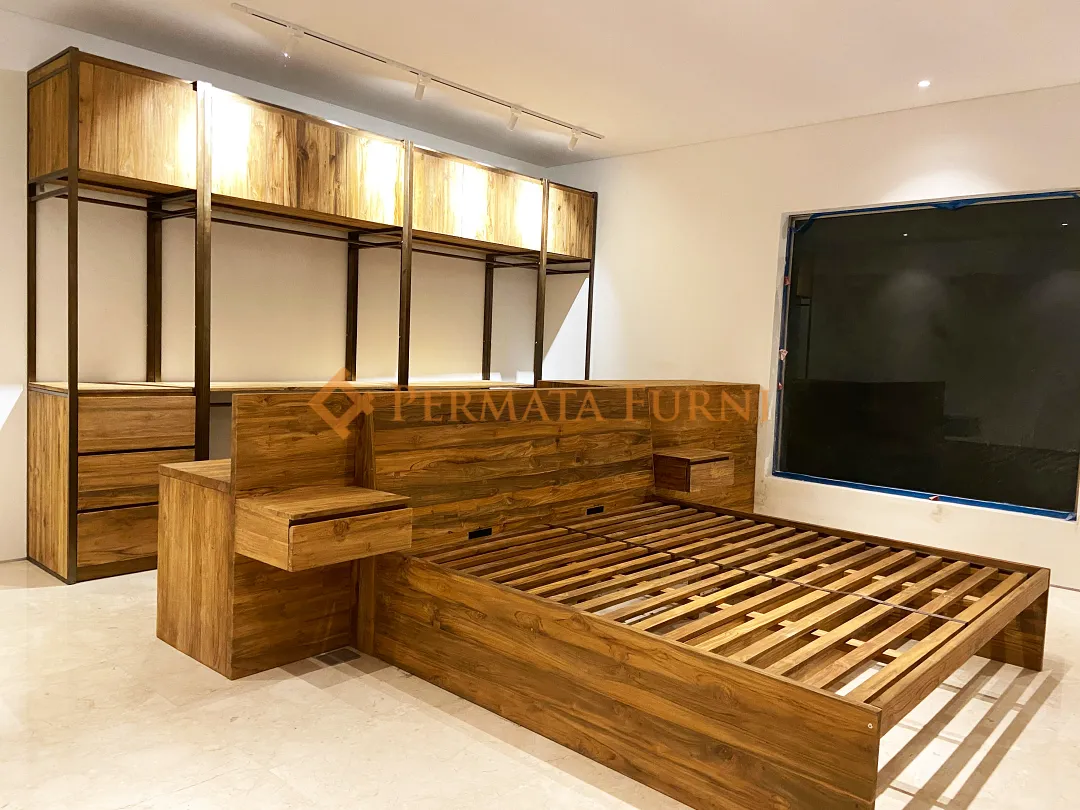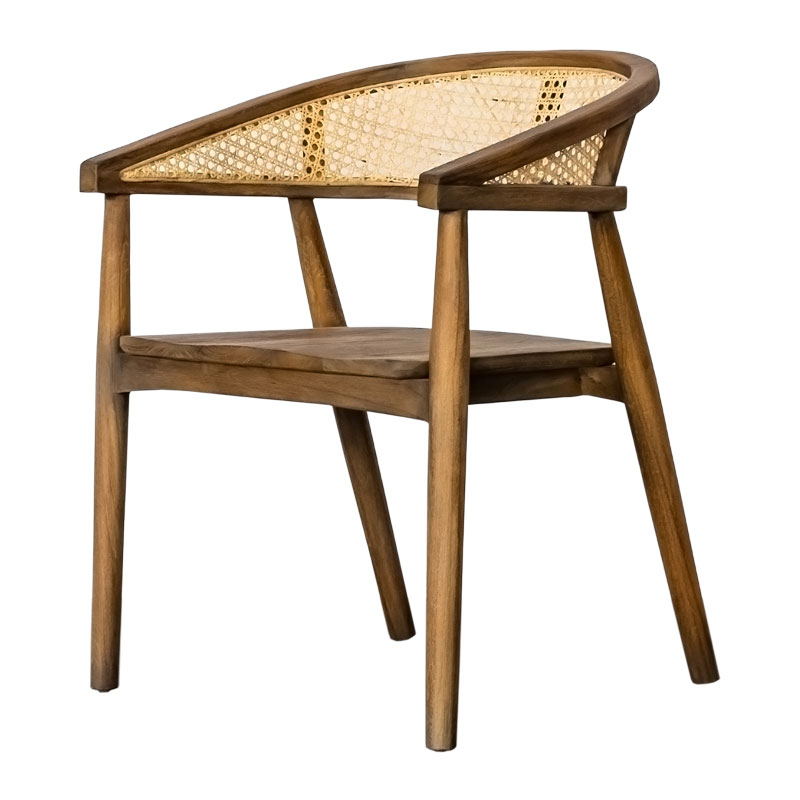


“Reclaimed teak” on a quote sheet tells you where the wood came from — not what quality you’re getting. Timber recovered from Javanese structures spans an enormous range: from massive, nearly clear house posts that re-mill into premium tabletop slabs, down to short, heavily weathered stock fit only for laminated panels. A serious manufacturer sorts all of it into grades, and a serious buyer understands what those grades mean before signing a purchase order.
This guide explains how reclaimed teak grading works in practice — at the beam yard, after milling, and on your quote — so you never pay Grade A prices for Grade C material. It is part of our complete guide to reclaimed teak furniture for B2B buyers.
Reclaimed teak arrives at the factory as recovered beams from demolished Javanese houses, barns, bridges, and warehouses. Each structure yields a mix: primary posts and beams that spent decades protected inside the frame, secondary members with more exposure and fixings, and smaller sections with heavy weathering or damage.
Grading is the process of sorting that mix by three criteria:
Large-section posts and primary beams (soko guru and equivalent members) with minimal defects after re-milling. Grade A yields wide, thick, largely clear boards — the only source for premium tabletop slabs (5cm+), long benches, and visible surfaces where customers expect clean, dense old-growth figure with restrained character marks.
Grade A is scarce by nature: only a fraction of any demolition yields sections this size and condition. Expect it to be priced accordingly, and expect honest suppliers to tell you when a requested dimension exceeds what current Grade A stock can deliver.
The workhorse grade. Solid, structurally sound timber carrying more character — nail holes, filled checks, stronger color variation — that remains fully fit for furniture. Grade B goes into table frames, chair and bench components, panel cores with visible faces in rustic-finish lines, and any application where character is a design feature rather than a defect.
Most of a typical reclaimed furniture order is Grade B, and that is correct: it delivers old-growth performance at a sensible price while Grade A is reserved for the surfaces that justify it.
Smaller sections, shorter lengths, heavier weathering, and more filled defects. Grade C is legitimate material with legitimate uses: laminated and finger-jointed panels, drawer components, internal blocking, and deliberately rustic product lines where deep weathering is the aesthetic. What Grade C should never be is the hidden substitute inside furniture quoted as Grade A/B.
This two-stage reality is why grade-consistent large orders require a factory with deep beam stock — a workshop buying beams job-by-job cannot guarantee the same grade profile across 300 pieces. It’s also why authenticating the material and auditing the factory go hand in hand.
A professional reclaimed teak quote states the grade per component, not a single blended label. A well-specified dining table line, for example:
| Component | Grade | Rationale |
|---|---|---|
| Tabletop (5cm slab) | A | Visible premium surface; wide clear boards |
| Legs and frame | B | Structural; character marks acceptable |
| Stretchers, aprons | B | Semi-visible; sound stock |
| Internal blocking | C | Hidden; short stock appropriate |
This transparency protects both sides: you know what you’re paying for, and the factory prices each component against the correct raw material cost. A quote that says only “reclaimed teak” with one price leaves the grade mix to the supplier’s discretion — which, with a poor supplier, means discretion you’ll discover after the container lands. Grade-mix ambiguity is also one of the pricing red flags covered in our reclaimed vs new teak comparison.
Grade describes the timber; it doesn’t guarantee the furniture. Pair grade specification with process QC:
Fluent, specific answers signal a factory with real grading discipline. Vague answers signal a blended-grade order priced at the top of the range.
No. A/B/C grading is an industry convention, not a certified standard — which is exactly why grade definitions, control samples, and variation tolerances should be written into your purchase agreement.
No — it is still old-growth teak, structurally legitimate for panels, internal components, and rustic lines. It only becomes a problem when sold at Grade A/B pricing or hidden inside premium-quoted furniture.
Scarcity and yield. Few recovered beams are large and clean enough to re-mill into wide clear slabs, and the 50–65% milling yield hits large sections hardest. Grade A output is a small fraction of any recovery batch.
Yes — that’s good practice, not deception, provided the quote states it: premium grades on visible surfaces, sound structural grades in frames, short stock in hidden components.
Through the control sample agreed at order confirmation plus pre-shipment inspection: check visible-surface boards for width, clarity, and character density against the reference, and spot-check end grain per our authentication guide.
RecycleTeak grades every board at our Semarang beam yard and states grades per component on every quote — with control samples, moisture logs, and live video tours of Grade A stock available to any serious buyer.



Reclaimed Teak Furniture Manufacturer & Hospitality Furniture Supplier, Indonesia. Sustainably Crafted. Wholesale & Custom Orders Welcome.