
A custom outdoor teak piece usually goes wrong on paper before it goes wrong in the workshop. The drawing looks right, the render looks great, and then the factory’s feasibility review flags a joint that traps water, a hardware call-out with no grade, or a section size the timber can’t deliver. This guide is for brands, architects and designers who are drawing custom outdoor teak furniture for OEM production, and it lists what to settle in the drawing so the first sample is close to the last.
We’re RecycleTeak, a reclaimed teak manufacturer in Semarang, and the points below come from the questions our team asks when a drawing arrives. For the commercial side, minimums, lead times and shipping, see our custom outdoor teak furniture OEM factory guide.
For OEM production, a drawing for outdoor teak furniture should state dimensions with the tolerances that matter, the timber and grade per part, the joinery for every connection, the hardware grade, the finish with a physical reference, and how the piece drains water, moves with the seasons and packs for shipping. Missing items become the factory’s decisions.
Indoor furniture details don’t survive rain, sun and salt air unchanged. These are the design moves that matter most for outdoor teak:
| Concern | Design response |
|---|---|
| Water pooling | Slatted or sloped horizontal surfaces, and no pockets or recesses that hold water |
| End grain | Keep end grain off the ground and out of standing water, and avoid exposed end grain on flat tops where you can |
| Seasonal movement | Teak is stable, but wide panels and long slats still move, so leave room for it in the details |
| Fasteners | Avoid screwing into end grain, use through-bolts where the load calls for them, and specify the hardware grade |
| Ground contact | Feet or glides that lift the frame off wet decks |
| Edges | Rounded edges and corners, which guests handle and finishes cling to better |
| Stability | Enough weight and footprint for wind, particularly for lightweight chairs and umbrellas |
Our core range is reclaimed teak recovered from demolished Javanese buildings. That changes how you draw, and it’s worth knowing before the first sketch:
| Item | What to include | Why the factory asks |
|---|---|---|
| Views and dimensions | Plan, front, side and section views, fully dimensioned, with units stated (mm or inches) | Mixed units are one of the most common causes of a wrong sample |
| Parts list | Every part with its timber, grade and finished size | The production planning team allocates graded stock from it |
| Joinery details | Mortise and tenon, dowel or bolted steel, shown per connection | The joint decides strength and how the piece sheds water |
| Hardware schedule | Type, size, finish and stainless grade, with 316 for coastal or poolside use | Cheaper grades stain and corrode in salt air |
| Finish | A named finish plus a physical or photographic reference, and the acceptable range | “Natural” means something different to every workshop |
| Critical dimensions | The tolerances that matter, such as seat height, table height and gaps between slats | Over-specifying every dimension on a natural material only raises cost |
| Packing constraints | Flat-pack or assembled, stack count, and carton limits | Our dining chairs and loungers can be designed to stack 6–10 units where storage is tight |
| Branding | Laser engraving, branded hardware or custom sling fabric | Placement has to be in the drawing |

You don’t need a full CAD package to begin. Dimensioned sketches or reference photos are enough to start a feasibility review, and CAD files help once you reach the sample stage because they remove doubt about joinery and tolerances. We accept drawings, CAD files and reference images, and our team reviews feasibility before quoting.
Once the drawing is in, our production planning team reviews it, flags anything that won’t hold outdoors, and returns notes before the sample is built. The sample takes 15 to 30 days, and production then takes 45 to 60 days from sample approval, with a minimum of 10 units per SKU on custom specifications. Treat the sample as an inspection: check every dimension, joint, finish and hardware item against the drawing, as set out in our hotel furniture procurement guide.
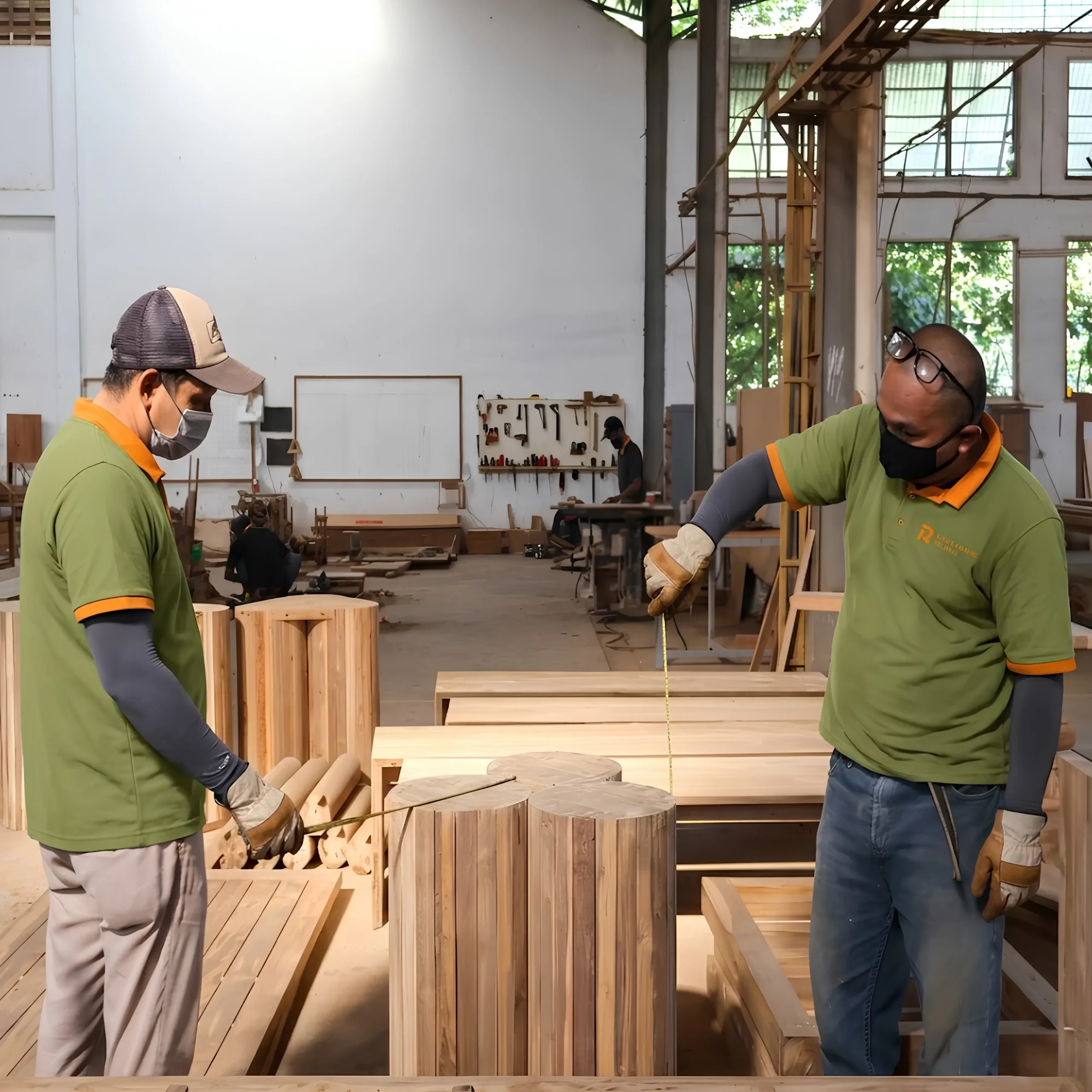
Dimensioned views, a parts list with timber and grade, joinery details, a hardware schedule with the stainless grade, a finish reference, the critical tolerances and any packing or stacking requirements. Dimensioned sketches or photos are enough to start a feasibility review.
Stainless steel, and 316 grade for coastal or poolside sites. State the grade, size and finish in the hardware schedule so the factory does not substitute a cheaper grade.
It depends on what the salvaged beams and boards yield. Ask the factory what section sizes are available before you finalize the design, and consider plantation teak where a specification needs consistent long sections.
Name the finish and give a physical or photographic reference with an acceptable range, because grain and tone vary from board to board. Natural teak oil is our standard, with other exterior finishes on request.
The sample takes 15 to 30 days, and production takes 45 to 60 days from sample approval. The minimum order is 10 units per SKU on custom specifications.
For the supplier and capability overview, see our custom teak furniture Indonesia supplier page, and for what to look for in a factory, choosing and auditing a teak outdoor furniture manufacturer. Have a drawing to review? Send it through our custom project page or the contact page, and our team will return feasibility notes with a quote.
Reclaimed Teak Furniture Manufacturer & Hospitality Furniture Supplier, Indonesia. Sustainably Crafted. Wholesale & Custom Orders Welcome.