
Buyers searching for a reclaimed teak price per cubic meter usually expect a single market number — like a commodity quote for plantation timber. That number doesn’t exist, and any supplier who quotes one without qualification is simplifying to the point of misleading. Reclaimed teak is not priced like a standing-forest commodity; it is priced like a recovered, hand-processed material whose cost is built through a chain of labor and yield losses.
This article shows you how that cost is constructed, what makes it move, how grades multiply it, and how to read a quote critically. It is part of our complete guide to reclaimed teak furniture for B2B buyers.
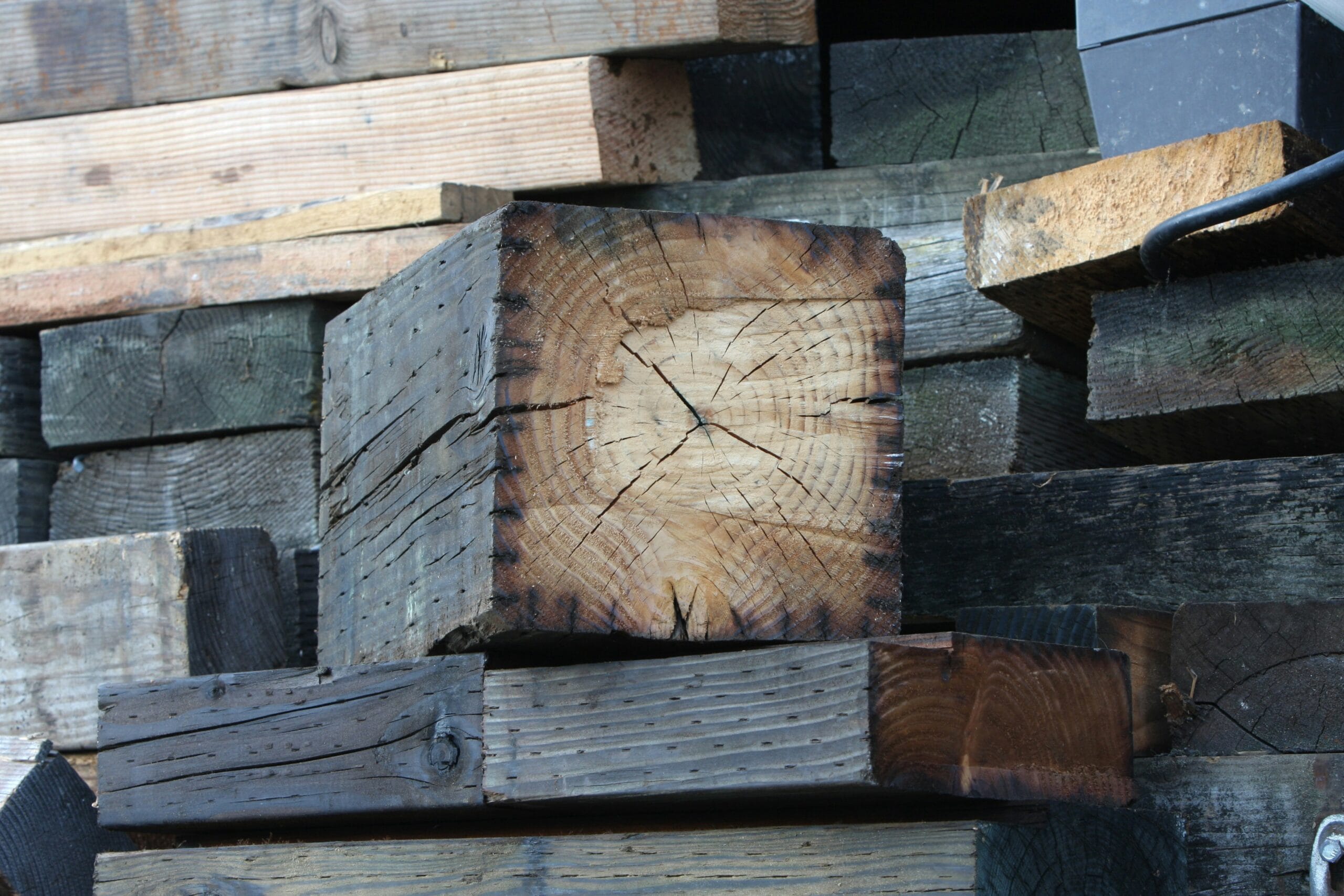
Plantation teak has a stumpage-based price: auction and concession prices for logs set a base, and sawn timber trades within known ranges. Reclaimed teak’s raw material is recovered beams from demolished Javanese structures — a supply stream that is decentralized, batch-based, and negotiated structure by structure across demolition networks in Central and East Java.
Three consequences follow:
Follow one cubic meter of raw recovered beams through processing and the pricing logic becomes clear:
The arithmetic that matters: the effective price per usable cubic meter is the raw cost plus processing, divided by yield. A batch with 50% yield costs roughly 30% more per finished board than an identical batch at 65% — from the same raw price. This is why quotes based on “raw beam equivalent” volume can look cheap and land expensive.
Because absolute prices move with supply seasons and currency, the honest way to present reclaimed pricing is relative to a common anchor. Taking kiln-dried plantation teak sawn timber as the baseline (1.0×), indicative positioning in the trade looks like this:
| Material (kiln-dried, furniture-ready) | Indicative index | Driver |
|---|---|---|
| Plantation teak sawn timber (baseline) | 1.0× | Commodity stumpage + sawing |
| Reclaimed Grade B/C mixed stock | ≈1.1–1.4× | Recovery labor, moderate yield loss |
| Reclaimed Grade B clear-face boards | ≈1.3–1.7× | Higher sorting standard, lower yield |
| Reclaimed Grade A wide boards | ≈1.8–2.5× | Scarcity of large clear sections |
| Reclaimed Grade A thick slabs (5cm+) | ≈2.5×+ | Rarest output of the recovery stream |
Indicative ranges only — actual multiples vary with recovery-market conditions, dimensions, and volume. Request a current, grade-specific quote for real numbers.
Two readings follow directly. First, entry-level reclaimed overlaps with good plantation pricing — the premium at the Grade B/C level is smaller than most buyers assume. Second, the premium concentrates dramatically in large clear sections, because Grade A stock is the scarcest output of every recovery batch.
For the finished-furniture side of the calculation — how material cost flows into container-load pricing, duties, and landed cost — see our guide to importing teak furniture from Indonesia.
There is no single market price — reclaimed teak trades batch by batch, and the number depends on grade, section size, processing stage, and recovery-season supply. Indicatively, furniture-ready reclaimed stock positions from roughly parity-plus with plantation sawn teak (mixed Grade B/C) to several multiples of it (Grade A thick slabs). Request a current grade-specific quote for real numbers.
Because the cost is labor, not stumpage: purchasing beams from demolition networks, hand de-nailing, metal detection, re-milling at 50–65% usable yield, and kiln verification. Each finished board carries that entire chain.
Few recovered beams are large and sound enough to re-mill into wide 5cm+ clear slabs, and milling losses hit large sections hardest. Grade A slab stock is the scarcest output of every recovery batch, and its price reflects that scarcity, not markup.
Occasionally — small-section Grade C stock and off-cuts trade cheaply and are legitimate for panels and hidden components. But full furniture quoted below plantation-equivalent prices as “reclaimed” almost always means misrepresented material, grade, or drying.
Through volume agreements with a factory holding deep beam stock: agreed grade definitions, control samples, and a pricing formula indexed to raw-beam market movement rather than a fixed number pretending the recovery market doesn’t move.
RecycleTeak buys recovered beams directly at our Semarang beam yard, mills and kilns in-house, and quotes grade-by-component — so the price you see maps to the actual material in your furniture.

Reclaimed Teak Furniture Manufacturer & Hospitality Furniture Supplier, Indonesia. Sustainably Crafted. Wholesale & Custom Orders Welcome.